

Recently, the academic annual conference titled “Towards 2030: Reshaping and Breakthroughs in Digital Business Education — 2026 Academic Annual Conference of the Digital Business Education Committee of the China Association for Educational Technology” was successfully held in Hangzhou, Zhejiang Province.
The conference was organized by the Digital Business Education Committee of the China Association for Educational Technology and hosted by Zhejiang Gongshang University.
Huang Youfang, Chairman of the Top 50 Shipping Elites Research Center (50SERC) and Chairman of the Teaching Guidance Committee of Higher Education Institutions of Logistics, Ministry of Education, was invited to attend the conference and deliver a keynote speech titled “The Mission and Opportunities of New Liberal Arts — Value Reconstruction and Core Empowerment of Liberal Arts in the AI Era.”
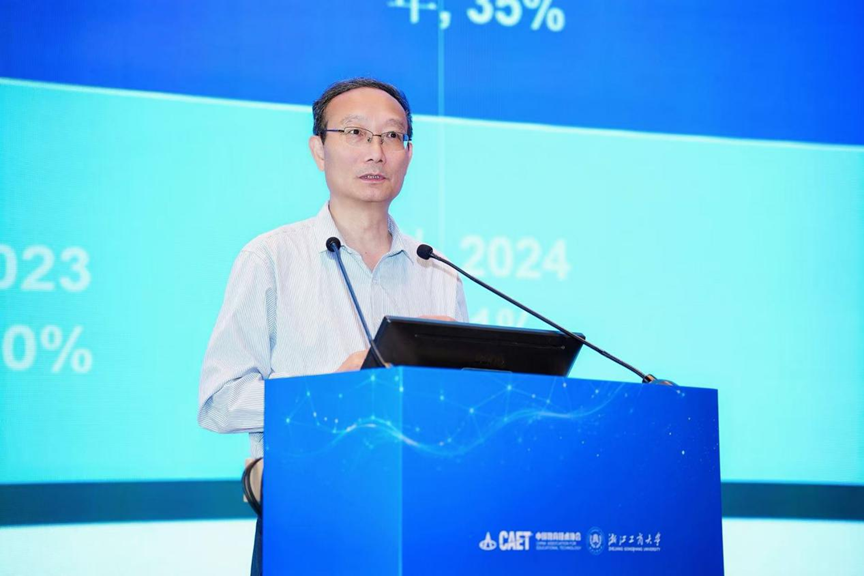
Professor Huang Youfang, Chairman of the Top 50 Shipping Elites Research Center (50SERC) and Chairman of the Teaching Guidance Committee of Higher Education Institutions of Logistics, Ministry of Education.
In his keynote speech, Chairman Huang emphasized that as AI technologies continue to mature, society’s demand for humanistic capabilities is becoming increasingly significant.
The proportion of liberal arts-related positions in leading AI companies has increased from 5% to 20%–30%, demonstrating the growing importance of humanities in technological development.
He noted that the core mission of liberal arts is to establish humanistic coordinates for an intelligent society and achieve mutual empowerment between AI and the new liberal arts.
AI provides the new liberal arts with technological tools and innovative paradigms, while the new liberal arts provide AI with ethical frameworks, value systems and scenario guidance.
Chairman Huang proposed a four-stage development pathway for liberal arts students, evolving from tool empowerment, job restructuring, value enhancement to discourse reconstruction.
He suggested that universities should rebuild talent cultivation systems based on the principle of “humanities as the foundation and technology as the driving force,” encouraging liberal arts students to transition from being observers of technology to becoming users, practitioners and leaders who can shape technological development.
Focusing on the theme of “Towards 2030: Reshaping and Breakthroughs in Digital Business Education,” the conference conducted systematic discussions on transformation pathways and practical exploration in business education under the background of digital technologies.
Experts attending the conference shared forward-looking insights and institutional practices from multiple perspectives, including disciplinary restructuring, talent cultivation, industry-education integration and textbook development.
Looking toward 2030, digital business education will continue to be problem-oriented and practice-driven, promoting systematic transformation in educational concepts, teaching models and evaluation systems, and providing strong support for cultivating interdisciplinary business talents equipped for the intelligent era.
Source:
School of Business Administration (MBA School), Zhejiang Gongshang University


