

Recently, the Global Transportation and Logistics International Forum, organized by the Water Transportation Sector of the World Transport Convention (WTC) and hosted by the School of Transportation Engineering of Chang’an University, was held in Tianjin.
Under the theme of “Multimodal Transport, Transport Corridors and the Security and Resilience of Global Logistics Systems,” the forum brought together experts and scholars from multiple countries to exchange the latest research findings in global transportation and logistics.
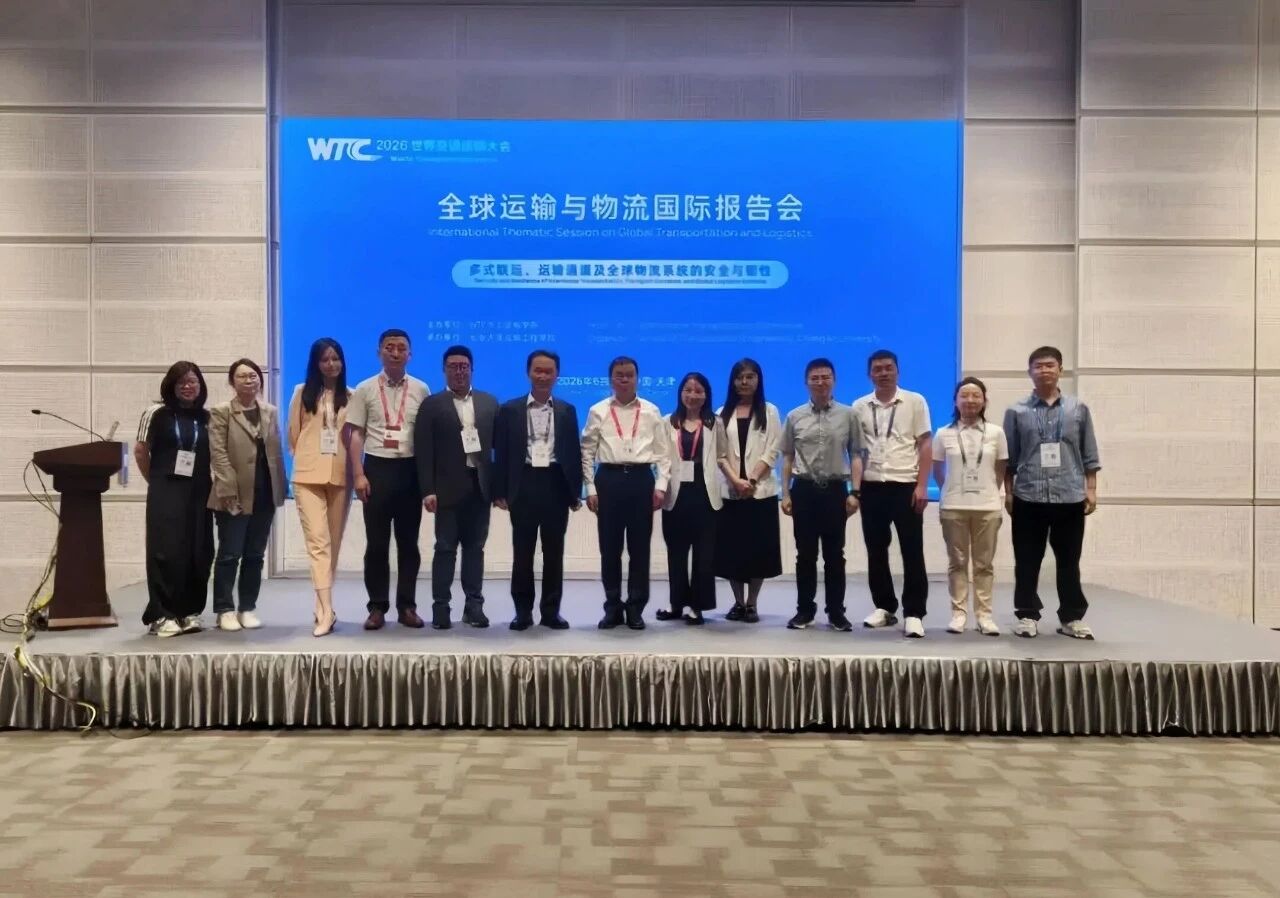
Participants and forum organizers at the conference.
The forum was chaired by Ge Ying’en, Expert of the Top 50 Shipping Elites Research Center (50SERC), Chairman of the WTC Water Transportation Sector, and Dean of the School of Transportation Engineering of Chang’an University.
In his opening remarks, Ge Ying’en reviewed the history of the forum, noting that the themed session was jointly initiated by Shanghai Maritime University and the University of Sydney during the first WTC in 2017.
Since its establishment, the forum has maintained an international and interdisciplinary focus, aiming to build a high-level academic exchange platform for international transportation and global logistics, while promoting talent development in related fields.
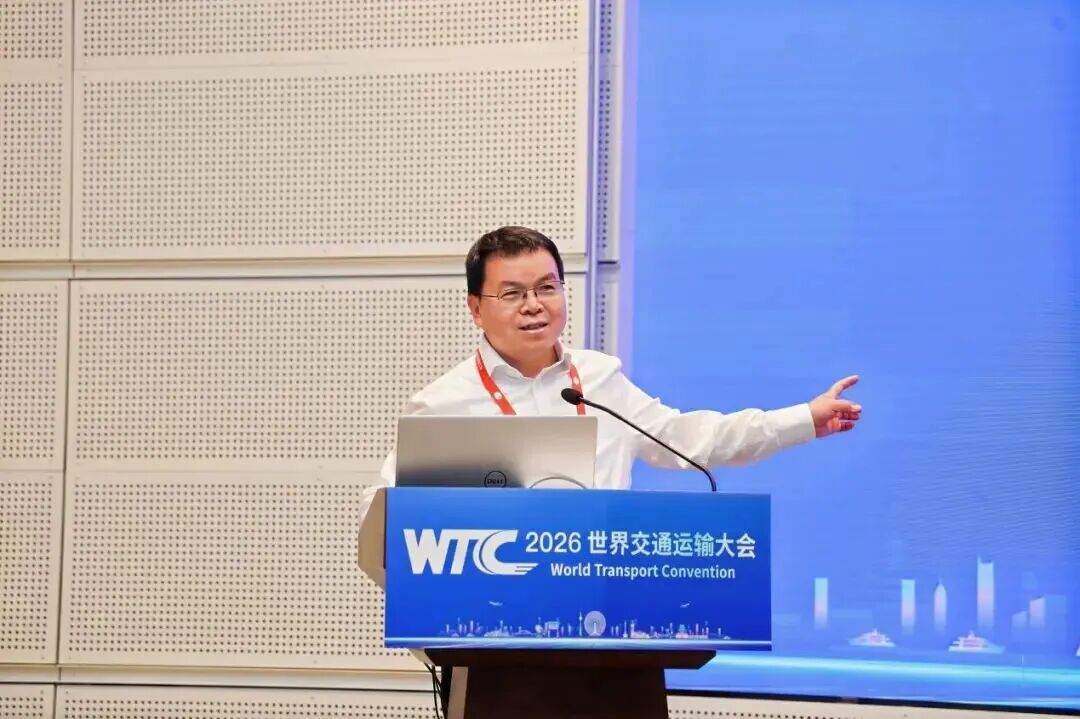
Ge Ying’en, Expert of the Top 50 Shipping Elites Research Center (50SERC), Chairman of the WTC Water Transportation Sector, and Dean of the School of Transportation Engineering of Chang’an University.
The forum featured five thematic presentations.
Lin Xiaoli, Professor of the Department of Technology, Management and Economics Operations and Supply Chain Management at the Technical University of Denmark, delivered an online presentation titled “A Framework of Ship-Shore Communication with the Adoption of Maritime Autonomous Surface Ships.”
She proposed a three-layer framework for ship-shore communication in autonomous vessels. The control layer adopts a hybrid centralized and decentralized approach to enable coordination between remote and local decision-making. The communication layer integrates technologies such as 4G/5G networks and satellite communications, while the security layer applies blockchain technology to ensure data integrity.
She emphasized that autonomous and conventional vessels will coexist for a long period in the future, requiring communication systems to support both operational modes. The proposed framework has been tested in the Copenhagen region and demonstrates strong potential for local adaptation.
Young-Tae Chang, Professor of the Asia Pacific School of Logistics at Inha University, South Korea, delivered a presentation titled “Why Some Nations and Companies Succeed and Fail in International Logistics.”
Using Singapore as an example, he explained that the government’s decisive adoption of containerization was a key factor behind Singapore’s emergence as a global transshipment hub.
Professor Chang also discussed five emerging directions for future logistics development, including supply chain diversification and Arctic shipping routes.
Choi Ziyu, PhD candidate from the Department of Industrial and Systems Engineering at The Hong Kong Polytechnic University, presented on behalf of Professor Xiao-Wen Fu, Head of the Department of Industrial and Systems Engineering at The Hong Kong Polytechnic University.
Her presentation, titled “Managing the Electrification Transition in Maritime Transport: Strategic Planning, Charging Resource Coordination and Subsidy Policy Design,” examined strategies for maritime electrification.
She highlighted that vessel electrification requires coordinated decision-making involving fleet renewal, charging infrastructure development and policy design.
Based on a case study of the Yangtze River Basin, the research found that shipping companies tend to prioritize the deployment of small electric vessels on downstream routes and develop charging facilities simultaneously to ensure operational reliability.
Regarding subsidy policies, the study suggested that when charging efficiency is low, subsidies should prioritize vessels or electricity costs, while when charging efficiency improves, subsidies for charging infrastructure become more effective.
The research also found that shore power provides greater emission reduction benefits than carbon taxation alone, while a combination of both measures achieves better results.
Professor Wu Gaiyu, Dean of the School of Business Administration at Beijing Normal University–Hong Kong Baptist University United International College, delivered a presentation titled “A Study on Disaster-Related Resilience Strategies along the Container Transportation Journey.”
Based on a systematic review of 230 academic papers, Professor Wu found that resilience research has been highly concentrated on seaport nodes, while upstream and downstream maritime operations as well as air cargo transportation have received limited attention.
The study also found that 97% of existing research does not apply management theories, and that resilience strategies are often disconnected from specific types of transportation disruptions. Regardless of disaster type, “increasing infrastructure investment” is frequently recommended as the primary response.
Professor Wu suggested that resilience strategies should better match disruption mechanisms and involve demand-side stakeholders in the design process.
Wu Xiaofan, Associate Professor at the Modern Logistics Research Center of the Institute of Economic and Social Development at Nankai University, delivered a presentation titled:
“U.S.-China Trade Friction and the Dynamics of Container Vessel Routine Deployment: Evidence from Global AIS Data.”
Using global AIS data, her research analyzed changes in container vessel deployment patterns under the impact of China-U.S. trade tensions.
The study found that after trade frictions intensified, vessel speeds on direct routes decreased by 3%–4%, average vessel size increased by 7%, and total capacity grew by 1.5%.
However, uncertainty-driven inventory accumulation by cargo owners eventually reduced shipping efficiency. At the same time, many feeder routes were suspended, the importance of traditional transshipment hubs declined, and emerging ports in countries such as Vietnam and Cambodia experienced significant capacity growth.
The research concluded that global shipping network restructuring is being driven by differentiated strategies adopted by carriers.
The forum provided an important platform for academic exchange in global logistics and shipping.
The latest research presented by participating experts revealed key challenges facing global transportation and modern logistics systems amid trade conflicts, climate change and technological transformation. It also provided new perspectives for enhancing the security and resilience of multimodal transport systems and transportation corridors.
Source:
China Highway Magazine
World Transport Convention (WTC)


