

Shanghai aims to have 280 kilometers of waterways at Grade III or above by 2030 and to raise the domestic waterborne share of container collection and distribution at Shanghai Port to 35%.
The Shanghai municipal government has released an implementation plan for building a Yangtze River Delta pilot zone for high-quality inland shipping and improving regional waterway connectivity from 2026 to 2030.
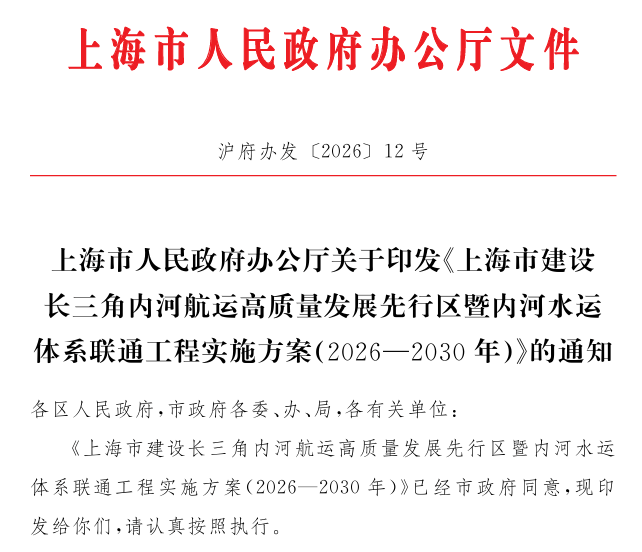
By 2030, Shanghai plans to bring 280 kilometers of waterways up to Grade III or above, build a number of consolidated public inland-port areas, expand the river-sea direct container corridor and raise the domestic waterborne share of Shanghai Port’s container collection and distribution to 35%. The plan also calls for greener, smarter inland shipping and an integrated river-sea transport network.
For waterway connectivity, Shanghai will develop an efficient direct river-sea container corridor linking interprovincial waterways—including the Sushen Outer Port Line, Hangshen Line and Hangpingshen Line—with the Huangpu River, Dalu Line and Yangshan Deep-Water Port.
The city will accelerate the eastern extension of the Dalu Line, improve capacity on the Sushen Outer Port Line and rebuild the western Dazhi River hub, creating a more efficient direct route between the Yangtze River Delta’s inland waterways and Yangshan.
Shanghai will coordinate cross-provincial waterway planning with neighboring provinces, remove bottlenecks and improve the Hangpingshen and Changhushen waterways. It will also advance upgrades to the Sushen Inner Port Line, Youdun Port and Luowen River and study the Dapu Line.
To support regional development, trunk waterways will be extended toward industrial parks. The city will improve feeder links and, where needed, develop short branch waterways connecting major industrial parks to the network’s final mile.
For port development, Shanghai will strengthen infrastructure around Xiaoyangshan and the Yangtze River estuary, accelerate the northern container terminal at Yangshan’s Xiaoyangshan area, complete phase two of the Luojing container-terminal conversion and improve sea-rail intermodal links.
The city will implement its 2025–2035 inland-port layout plan and develop consolidated, green and intelligent demonstration port areas such as Baihe and Waigaoqiao. It will also improve lifecycle management of port shorelines and streamline approvals.
Existing specialized inland terminals will be adjusted or upgraded in line with land-use planning and regional needs. Port areas may be developed together with logistics parks to promote port-industry-city integration and safeguard supplies of construction materials, grain and energy.
Shanghai will continue expanding domestic water-to-water transshipment and river-sea direct services, increase inland container terminal business in the Yangtze River Delta and promote standardized vessel renewal and larger river-sea fleets.
The plan also calls for a unified and open shipping market, stronger inland-shipping enterprises, support for digital freight platforms, more capable multimodal transport operators and end-to-end single-document services, together with fairer market supervision and standardized charging practices.


